Category: Must Read

  • ART AMONG THE ROOFTOPS

    ART AMONG THE ROOFTOPS

    [inpost_galleria thumb_width=”200″ thumb_height=”200″ post_id=”702″ thumb_margin_left=”3″ thumb_margin_bottom=”0″ thumb_border_radius=”2″ thumb_shadow=”0 1px 4px rgba(0, 0, 0, 0.2)” id=”” random=”0″ group=”0″ border=”” show_in_popup=”0″ album_cover=”” album_cover_width=”200″ album_cover_height=”200″ popup_width=”800″ popup_max_height=”600″ popup_title=”Gallery” type=”yoxview” sc_id=”sc1428347442118″]

    FERRAGUDO WELCOMES ARTE ALGARVE’S NEWEST GALLERY

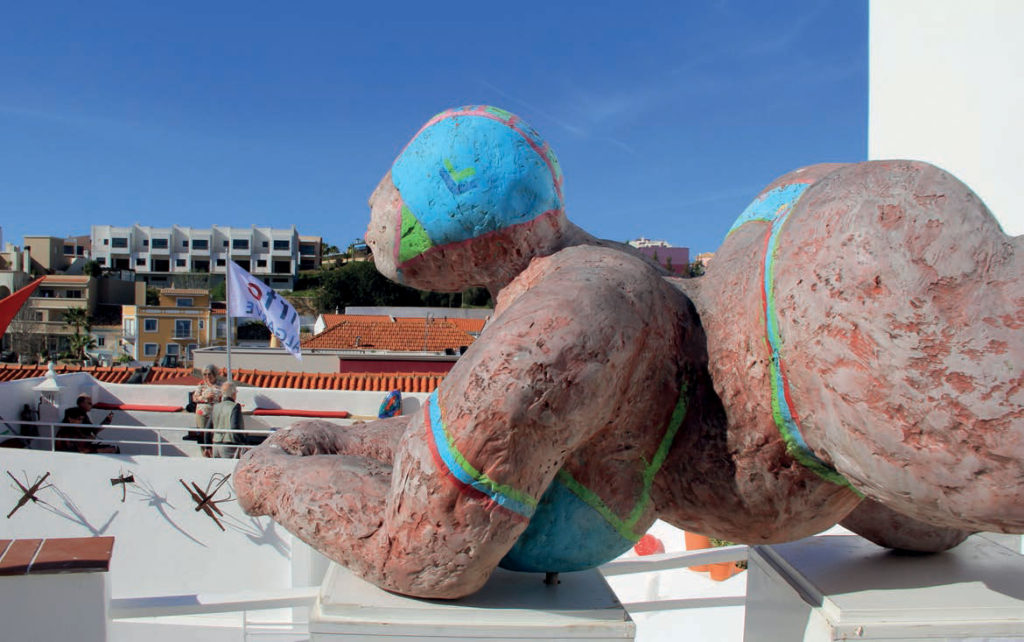
    If Rolf Osang were ever to open a new gallery, it would have to be something quite special to follow in the footsteps of Arte Algarve, whose artworks hang on the walls of ÚNICA, a working winery in Lagoa. Four-and-a-half years after it first opened, the gallery owner has finally found what he deemed to be the perfect place for a second exhibition centre: a quirky townhouse in the fishing town of Ferragudo. Officially opened in March, the new Arte Algarve gallery is housed in a building just off the main square, on Rua 25 de Abril, and its pretty façade conceals a spacious venue set across I three storeys. Inside, the ground floor comprises three divisions of different sizes, where much of the theme is dedicated to the Algarve and the Alentejo regions. Walking up the stone steps, a small hallway leads to four further divisions, all of which boast the same natural light, original hardwood floors, exposed bricks, comfy sofas and restored antique furniture that enhance the many artworks on display here. The paintings and portraits are hung in an original way ­ on metal frames that lend a workshop-feel to the gallery but which are also reminiscent of the town’s fishermen’s nets. The pièce de résistance, however, is a truly unexpected gem: the exterior terrace that extends across four different levels amidst the rooftops of Ferragudo. Offering a completely different perspective of the town, surrounded by chimneys and overlooked by one or two neighbouring cats, the outdoor area is also dotted with pretty and original artworks, from the stone sculptures in the newly planted garden and the metal insect sculptures placed on the walls, to the large wooden table that takes up most of the terrace which affords a pretty seating area with views of the bay. In all, there are around 15 artists represented here, all of different backgrounds but with connections to the region. “The Lagoa gallery is a fantastic, unique building, but we don’t get many tourists or passers-by. We thought we needed a second gallery in a beautiful place, with an authentic atmosphere and lots of individual travellers, and Ferragudo is truly the ideal place,” said gallery director Rolf Osang. While visitors got a first peek of the gallery at the vernissage on a sunny afternoon in March, where they enjoyed the wines from Quinta do Barradas and live music courtesy of Cory Sea, the gallery and its charming terrace will no doubt shine even brighter as the evenings get warmer. The Arte Algarve Ferragudo gallery is open from Tuesday to Sunday from 11am to 3pm and 6pm to 9pm, and until late during the summer months.

    www.artealgarve.net 16

  • SPRING SKINCARE

    SPRING SKINCARE

    [inpost_galleria thumb_width=”175″ thumb_height=”175″ post_id=”695″ thumb_margin_left=”3″ thumb_margin_bottom=”0″ thumb_border_radius=”2″ thumb_shadow=”0 1px 4px rgba(0, 0, 0, 0.2)” id=”” random=”0″ group=”0″ border=”” show_in_popup=”0″ album_cover=”” album_cover_width=”200″ album_cover_height=”200″ popup_width=”800″ popup_max_height=”600″ popup_title=”Gallery” type=”yoxview” sc_id=”sc1428347094168″]

    Like many before him, and no doubt many after, Dutchman Ron Voskamp fell in love with Ferragudo the moment he laid eyes on this charming fishing town. And while this is where his business is based, in a tiny showroom right on the main square, it is not Ferragudo he is promoting, but the mountain town of Monchique, more specifically, its spring water. The natural springs of Caldas de Monchique, the only termas in the Algarve, have been frequented since Roman times thanks to the healing properties of the water. In fact, the name Monchique comes from mons siccus, meaning ‘thirsty mountain’ in Latin. Thousands of years later, one company is harvesting the benefits of this magic potion in its skincare range, suitably named Monchique Cosmetics. From masks, scrubs, peelings and foot and hand cream to bath products, eye cream, serums and makeup remover, presented in an elegant blue and white packaging, the products all share a common link: Monchique’s very own H2O. But this is no ordinary water; it is a special combination of extremely pure H2O, free from bacteria and other contaminants, and which contains calming and smoothing properties. It is also extremely alkaline, reduces acidity in the body and neutralises free radicals. With two degrees ­ one in Engineering and another in Business Economics ­, Ron Voskamp had a physical and 40 mental breakdown around five years ago which made him decide to slow down and adopt a healthier lifestyle. It was during this process that he discovered the benefits attributed to alkaline water: although not scientifically proven, some experts believe it has antioxidant properties, helping to control hormones and even prevent cancer. It was therefore a surprise for the businessman that he could buy alkaline water from Monchique directly from the Algarve’s supermarkets when he came to the region around two years ago to write a book. It wasn’t long before Ron met fellow compatriot Agnes Hesselink, who has more than 20 years’ experience heading a Dutch skincare development and production company, and who had already discovered the benefits associated to the Portuguese water. With products for all ages and skin types, for both men and women, Monchique Cosmetics is “one of the purest ranges of cosmetics”, according to the director, and offers products that can be used at home, as well as in treatments at selected salons and spas. However, the products aren’t only based on Monchique water, but also on a well-known local fruit, which, curiously, is also drunk in the form of fire water ­ medronho. These two components are the key elements of a complex made from five ingredients, which dramatically improves skin’s hydration and which is the base of all the brand’s products ­ MIH5, the Monchique Intensive Hydration 5 Complex. “The powerful medronho extract is rich in the antioxidant vitamins C and E, which protect the skin from damage caused by free radicals and allow other ingredients to deeply penetrate the skin, and in omega-3 and 6 acids, which help reduce inflammation,” explains Ron, noting that the water’s fine molecular structure makes it Ron Voskamp easily absorbed by the body. Now living in Ferragudo, whose picturesque bay dotted with fishing boats had always been a dream location for the businessman, and embraced by the local community (every Saturday the Dutchman would play dominoes at the town’s senior citizens’ centre), it was only natural that the Monchique Cosmetics showroom would be here. While the space can be visited by appointment, the products can also be found in Caldas de Monchique and at the Vila Monchique shop, as well as at other selected locations 41 COSMETICS Ron Voskamp with Rui André across the Algarve. The idea is that in the future, the brand will be present countrywide, including the islands of Madeira and the Azores. According to the businessman, “I believe that with Monchique Cosmetics, we can contribute to people’s awareness of health and beauty, inside and out, and generate interest in Monchique and in Portugal, and thus contribute to tourism”. While the skincare line is produced in the Netherlands, the aim is to bring production to Monchique and provide employment for the local people. “It’s about shared values, and about promoting Monchique through these cosmetics,” he says. In this mission, the brand has an important partner: the president of Monchique Câmara, Rui André, who supports the project and to whom Ron and Agnes gave some of their products in a special launch box, made from the best Algarvean cork from Novacortiça. https://www.monchiquecosmeticsportugal.com 42

  • SURF THE SKY

    SURF THE SKY

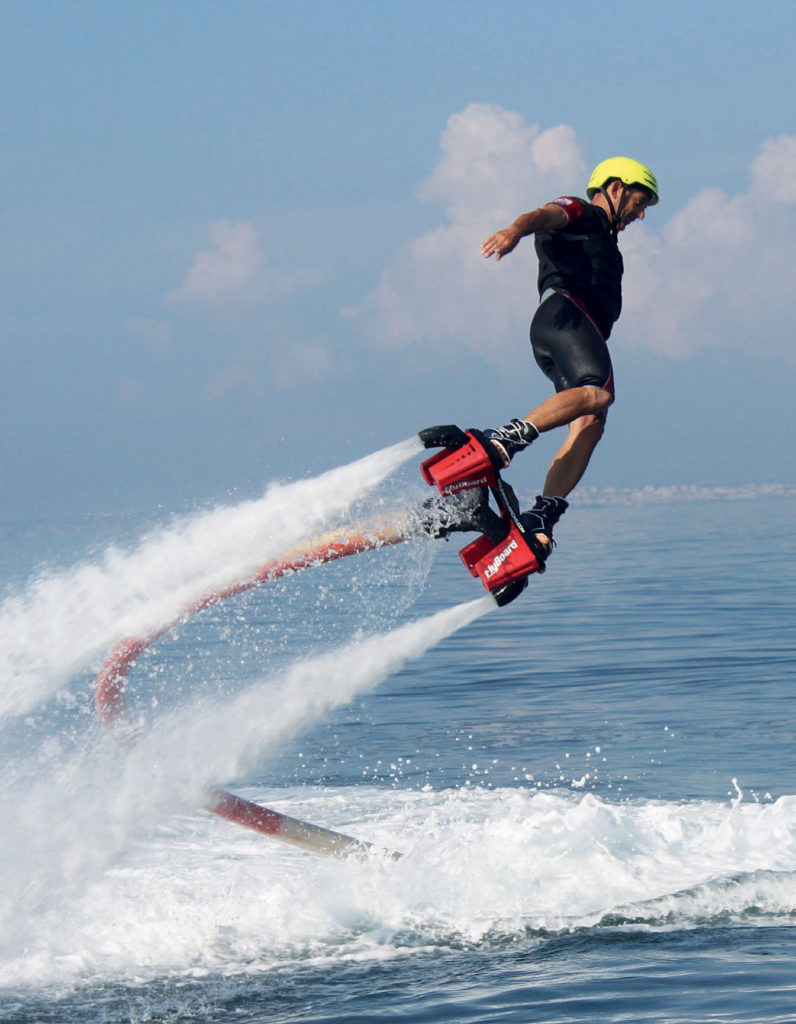
    IS IT A BIRD? IS IT A PLANE? NO, IT’S A FLYBOARD jetpack that shoots you up into the air and lets you leap in and out of the water like a dolphin all sounds very futuristic, but it’s actually a pretty common sighting just off the beach at Praia da Rocha. It’s called flyboarding and it’s the latest watersport to arrive in the Algarve. “We have been selling jet skis in the Algarve for more than 20 years, so it made perfect sense for us to introduce flyboarding,” said Stefania Balzer, a former Aquabike world A champion and marketing coordinator of the Angel Pilot Group, the company that distributes the Flyboard here in the region. Based in Parchal, Angel Pilot was set up in 1991 by Stefania’s father, Alessandro Balzer, an Italian jet ski champion with his fair share of European and world jet ski titles. It was during one of these international competitions ­ the Jet Ski World Championship in China in 2011 ­ that the Angel Pilot team witnessed first-hand the presentation of the Flyboard, 23 2 ACTIVITY an ingenious device that attaches to a personal water craft ­ in this case a jet ski ­, and propels the rider into the air and through the water. It was clear from the start that flyboarding and Angel Pilot were the perfect fit. Invented by jet ski champion Franky Zapata, the Flyboard is similar to a wakeboard, where the rider’s feet are strapped into boots with jet nozzles underneath, which are connected to the jet ski’s turbine through a long hose. Using the power of the jet ski, the rider can be thrust up to a dizzying 14 metres into the sky. It took months of waiting for the legislation to be approved, but in August last year, Angel Pilot finally got the nod to provide this unique experience to clients across the Algarve. As well as being the region’s official distributors of the Flyboard, the company also has three certified instructors who can teach clients how to manoeuvre this state-of-the-art equipment. “It’s a great sensation. At first it can be a bit nerve-racking but you soon get the hang of it!” says a smiling Stefania, who is one of the certified instructors to take clients out to their official flyboarding spot just by the mole at Praia da Rocha. “At the beginning it’s that feeling of being up high and seeing everything from a different perspective, you get a feeling of freedom. Then when you get the hang of it and move around a bit better, you can have lots of fun.” Open to anyone over the age of 16, Stefania notes that some people are quicker to pick it up than others. “Some people can get up high very quickly, others take a little longer to adapt. It has to do with the balance and the person’s understanding of how it works. You have to straighten your legs when it starts up, but for some reason there’s a natural tendency to bend your knees and that makes it harder. There are those who catch on to that straight away and those who don’t.” 24 SPORT Once you have commanded the technique and gained some height ­ during these ‘courses’, the maximum height you can reach is four metres ­, you can start doing twists and turns and dive like a dolphin into the water. More practised riders can do flips, spins, back-flips and other aerial stunts, with a number of professional flyboarding competitions already taking place around the world (the first Flyboard World Championships took place in Qatar in 2012). But for beginners and amateurs, the courses led by the Angel Pilot team sees groups of at least four people heading out to Praia da Rocha to try their hand at the region’s latest watersport. After receiving a briefing on the boat, during which time the team prepares the equipment on the jet ski, clients are given a life jacket and helmet, and a wetsuit when it’s colder, for the experience which lasts 20 minutes. “As long as people follow our instructions, there are no dangers at all,” assures Stefania. The legislation is also somewhat limiting, according to the marketing coordinator, and requires that a boat accompanies all the courses, which must take place outside the sea walls, making it particularly challenging in the winter months. However, it means that those who don’t want to try flyboarding can still join in, take pictures and enjoy a few hours out on the boat. While the 90 price tag makes it a more special experience, Angel Pilot offers reduced prices for large groups, and has created gift vouchers for the summer which are perfect as a birthday present.

    www.angelpilot.com [inpost_galleria thumb_width=”175″ thumb_height=”175″ post_id=”692″ thumb_margin_left=”3″ thumb_margin_bottom=”0″ thumb_border_radius=”2″ thumb_shadow=”0 1px 4px rgba(0, 0, 0, 0.2)” id=”” random=”0″ group=”0″ border=”” show_in_popup=”0″ album_cover=”” album_cover_width=”200″ album_cover_height=”200″ popup_width=”800″ popup_max_height=”600″ popup_title=”Gallery” type=”yoxview” sc_id=”sc1428344258962″]

  • URBAN CANVAS

    URBAN CANVAS

    ARMED WITH SPRAY CANS AND AN EYE FOR DETAIL, STEPHEN JONES IS SET ON CHANGING THE IDEA OF GRAFFITI FOR THE BETTER

    [inpost_gallery thumb_width=”175″ thumb_height=”175″ post_id=”385″ thumb_margin_left=”0″ thumb_margin_bottom=”10″ thumb_border_radius=”10″ thumb_shadow=”0 1px 4px rgba(0, 0, 0, 0.2)” js_play_delay=”3000″ id=”” random=”0″ group=”0″ border=”” type=”yoxview” show_in_popup=”0″ album_cover=”” album_cover_width=”200″ album_cover_height=”200″ popup_width=”800″ popup_max_height=”600″ popup_title=”Gallery” sc_id=”sc1422639033869″]


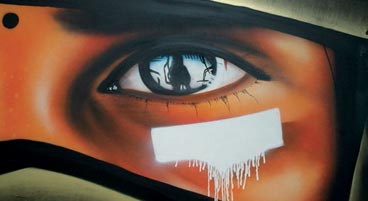
    It may have a negative connotation usually associated to vandalism but, wall by wall, Lagoa resident Stephen Jones is slowly changing people’s perception of graffiti. “Graffiti isn’t just tags and scribbles,” says the 22-year-old artist, “and the only way for people to understand that is to make beautiful, appealing graffiti that they enjoy looking at, and gradually they will start having a different perception of it.” One work that is certainly going some way to achieve that is the mural of Carvoeiro beach, created from a photograph taken by local photographer Jorge Fonseca on the side of a house, which welcomes visitors driving in through Rua dos Pescadores. This is the first of many projects that Stephen has done in collaboration with the União das Freguesias de Lagoa e Carvoeiro, a clear sign that the latest local council is certainly keeping up with the times.

    But how did this once sleepy fishing village become a canvas for colourful spray paints? Much of it, says Stephen, is down to word of mouth. Having collaborated on some graffiti commissions ­ his work can be seen at J BarBara bar and the Carvoeiro scouts’ headquarters, with a Jungle Book theme ­, he was later approached to do other projects individually, such as the tropical theme at Charly’s Bar. And whilst much of his work can be seen elsewhere, from a BMX track in Quarteira to a portrait of Salvador Dali at the Satori art association in Salir, it is Lagoa council itself that is helping to place its home-grown artist in the spotlight. “It was one Carnival when I helped paint some of the floats for the Carvoeiro parade. People spoke about it, word got out of the work I had been doing and when the local authorities changed, they wanted to do something new.”

    Following the Carvoeiro mural, other substantial municipal projects are already underway. In the south entrance of Lagoa, by the EN125 roundabout towards Estombar and Portimão, a wall has been earmarked for Stephen to paint some of the city’s most important landmarks, such as the convent, the market and the church, whilst on the opposite side of Lagoa, towards Silves, the graffiti artist is portraying the late Fernando Rodrigues, Lagoa’s most important potter, as part of a theme dedicated to pottery. But whilst nowadays, Stephen, whose father is English and mother is Portuguese, works alongside the council, in his youth, his artistic work wasn’t quite so legal. Experimenting with graffiti from the age of nine or ten, during his teens he set aside the spray cans and dedicated more time to skateboarding. In need of money to buy new boards, he turned to tennis coaching, a sport in which he had excelled for many years, before finding his vocation as a street artist. With no formal artistic training, besides drawing a lot in his childhood, most of his commissioned work follows a specific brief, but, left to his own devices, Stephen says he enjoys doing faces and landscapes. “I get a certain feeling when I first look at a face, and if I pay attention to that feeling, I keep painting until I can achieve that same feeling.” It’s frustrating work, even for this laid-back artist who admits that, when he starts a new project, he never knows how it will come out. Aside from graffiti, he also spends much of his time sketching, and he does many portraits with pen and paper.

    Finding inspiration “in life, in everything” and working better during introspective moments, Stephen notes that the advantage of graffiti is that it can be done anywhere, but he wants to showcase more of his work in public spaces to reach a wider audience. In fact, his goal is to make people who are walking by stop dead in their tracks. “In the faces, I try to create an expression, an intense, profound look, that’s something of a shock, one that’s able to create a moment of silence and make people think.” His dream, however, goes further than that: “I would love to do buildings; the whole side for everyone to see,” he smiles. But is Lagoa council ready for that? “Not all of a sudden. It’s a big shock, but bit by bit, people are seeing this type of work and they’re starting to accept it.”
    To see more of Stephen Jones’s work, check out his Facebook page.

  • THE ART OF HOSPITALITY

    THE ART OF HOSPITALITY

    SHAPING THE NEXT GENERATION OF FOOD AND BEVERAGE PROFESSIONALS: MEET THE HOSPITALITY AND TOURISM SCHOOL OF PORTIMÃO

    [inpost_gallery thumb_width=”175″ thumb_height=”175″ post_id=”383″ thumb_margin_left=”0″ thumb_margin_bottom=”10″ thumb_border_radius=”2″ thumb_shadow=”0 1px 4px rgba(0, 0, 0, 0.2)” js_play_delay=”3000″ id=”” random=”0″ group=”0″ border=”” type=”yoxview” show_in_popup=”0″ album_cover=”” album_cover_width=”200″ album_cover_height=”200″ popup_width=”800″ popup_max_height=”600″ popup_title=”Gallery” sc_id=”sc1422639201183″]


    Tourism is without a doubt the backbone of the Algarve’s economy, sustained by luxury hotels and quality bars and restaurants that provide the finest standards of gastronomy and service. For that, in the most part, we can thank the much-acclaimed Hospitality and Tourism School in Portimão. Created in 1970 ­ the third in the country and second in the region ­ on the city’s riverside, at a time when the Western Algarve was desperate for a vocational training centre, the school moved premises as it grew in student body and reputation. Today, the Escola de Hotelaria e Turismo de Portimão (EHT Portimão) is located in the Pedra Mourinha area of the city, and retains its status as one of the best hospitality schools in the country. Part of the school network of the national tourism authority Turismo de Portugal, EHT Portimão comprises two blocks ­ one dedicated to administration and management, with an IT room and library, and the other holding the classrooms, technical lab areas such as kitchen and demonstration restaurant and bar, and students’ bar. There’s also a residence during term-time that’s open to students who live more than 50km away from the school, or who don’t have any possible means of transportation. Although the building wasn’t purpose-built, the school’s director, Pedro Moreira, is the first to note that it hasn’t held them back: “After all, within the culture we want to develop, our motto is to transform challenges into opportunities.” It’s this attitude, paired with the highest training standards delivered by experienced tutors who are also leaders in their field, that attracts pupils from around the country to train at this centre of excellence on the Algarvean coast. The school offers two course levels: the Level IV Dual Certification Courses, such as Cooking and Pastry Techniques, aimed at under-25s who have completed 9th grade and want to gain vocational training whilst also completing their school education; and Level V Technological Specialisation Courses for those looking for an alternative to higher education. The school’s “speciality”, however, which has produced some of the country’s finest hospitality professionals, is the Level V Hospitality Management – Food & Drink (Gestão Hoteleira Restauração e Bebidas). The jewel in the school’s crown, this specialist course sets out to produce well-rounded and highly skilled F&B professionals, with reallife practical training alongside subjects such as cost-control, menu engineering and marketing. “All the courses are complementary, particularly on the practical side ­ those who cook need someone to serve what they create, and those who wait need something to serve,” explains Pedro Moreira, who is also the director of the Hospitality and Tourism School of the Algarve, in Faro.

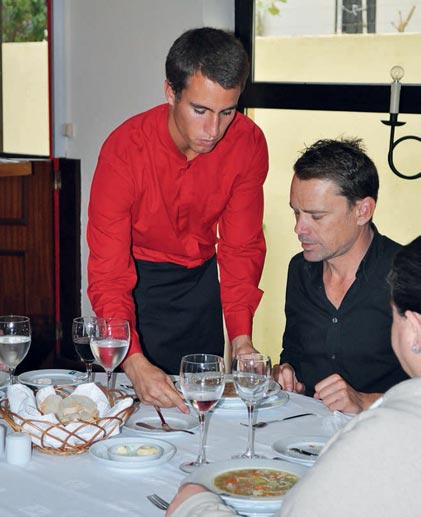
    Everything in the school, he emphasises, is made by the pupils, guided and overseen by the tutors. In fact, every day is a real-life scenario for the students at EHT Portimão, from the impeccable uniforms (the men must also be clean-shaven and all visible piercings removed) to the typical codes of conduct followed by any prestigious hotel unit. “Our motto is almost military in its approach: ‘Train hard, fight easy’. The more accustomed our students are to the correct rules and regulations, the easier it is to follow the highest standards of hospitality elsewhere.” Of course, this approach is put into practice daily with “reallife” customers, as the school’s restaurant is open for lunch to outside visitors, with a set three-course menu (including wine, coffee and water) available from just 12.50 (booking advisable). Special menus can also be created by request. But it’s not just within the school walls that the pupils get their training. Whilst EHT Portimão can provide kitchen and waiting teams for any private event upon request (and where logistics allow), the school also has important partnerships with the region’s leading hotels and provides staff where needed. For Vila Joya’s prestigious International Gourmet Festival, for example, EHT pupils were drafted to support the world’s best chefs. “It’s a huge advantage for our students, but I also feel it’s an advantage for our partners who benefit from the youth and professionalism that our students bring,” believes the director.

    However, there is no better representation of the school’s teaching excellence than the alumni itself. Some of the region’s best bartenders, waiters, cooks and pastry chefs were trained here, and a number of former students are now executive chefs, F&B directors and department managers at leading restaurants and hotels, both here in Portugal and abroad. In fact, the school prides itself on including many former pupils ­ and now industry leaders ­ in their faculty, to ensure the continued excellence of EHT Portimão. “Of course we’re not bound by the values from 1970, but this mixture of incorporating former students and new people who come in with a different outlook and new input of the market ensures that we truly have a very strong, very cohesive and very upto-date culture,” says Pedro Moreira, himself a former pupil here who progressed rapidly through the ranks at Penina Hotel before deciding to dedicate his life to teaching.

    Noting that the industry recognises the skills and professionalism of EHT pupils countrywide, the Algarve director notes that demand remains high for these highly trained individuals. After all, that is the ultimate goal of these schools: “Our motivation is of course the employability and success of our students, and when they come back to tell us about their experience here and how it helped them with their professional success, it’s hugely rewarding,” admits Pedro Moreira. “That is exactly what we work for, to know that they have done well professionally and that they recognise the school was important in their lives.”

    www.escolas.turismodeportugal.pt/escola/ escola-de-hotelaria-e-turismo-de-portimao
  • SIGNATURE INSPIRATION

    SIGNATURE INSPIRATION

    JEWELLER NUNO LOPES CREATES PIECES THAT ARE JUST LIKE THE PEOPLE WHO WEAR THEM: ONE OF A KIND

    [inpost_gallery thumb_width=”175″ thumb_height=”175″ post_id=”381″ thumb_margin_left=”0″ thumb_margin_bottom=”10″ thumb_border_radius=”2″ thumb_shadow=”0 1px 4px rgba(0, 0, 0, 0.2)” js_play_delay=”3000″ id=”” random=”0″ group=”0″ border=”” type=”yoxview” show_in_popup=”0″ album_cover=”” album_cover_width=”200″ album_cover_height=”200″ popup_width=”800″ popup_max_height=”600″ popup_title=”Gallery” sc_id=”sc1422639472855″]


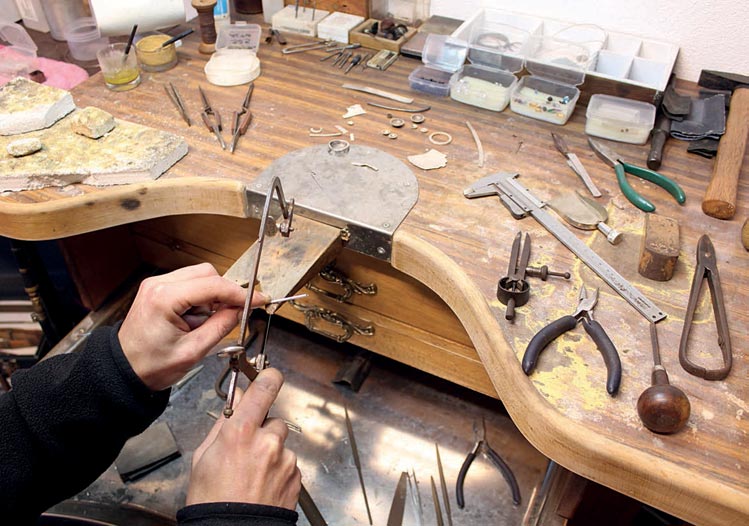
    We first spotted Nuno Lopes at the Fatacil fair in Lagoa, working away on a piece of silver as a couple of children stood by, mesmerised. We later found out that some of these children return to his stand, year after year, to watch the jeweller at work, and often get a simple band as a reward for their curiosity. For Nuno, it’s not just about promoting his work ­ beautiful one-of-a-kind pieces designed by his fair hand: “I remember coming here as a kid and losing myself in the crafts tents. I loved watching the artisans at work, so it makes me proud when children come here and ask me questions.”

    Although his love of arts and crafts stems from his childhood, jewellery wasn’t his full-time vocation. Originally from Portimão, Nuno admits he was influenced by social norms and enrolled at university to study the sensible but admittedly less artistic Agriculture and Animal Husbandry. He specialised in Aquaculture, a course he didn’t complete but which led him to work as a fish inspector in the capital. But jewellery would always be in the background ­ also prompted by a chance meeting with an Argentinian jeweller in Brazil ­, and it was in Lisbon that he took his first jewellery course at the age of 24. On his return south, however, he became disillusioned with where his life was going and, thanks to his Spanish girlfriend at that time, Carmen, who he credits for being the person that most helped him on his journey, he moved to Spain. He did several courses in jewellery and diamonds in Seville and studied gemology at the Spanish Gemological Institute in Madrid. After being invited to work in the centre’s workshop, in 2012, Nuno returned to his hometown of Portimão. At last, he was where he wanted to be: with a workshop set up in his parents’ garage and extensive training behind him, Nuno Lopes was free to create the signature pieces that have been making waves across the Algarve and beyond. Mostly working with silver and incorporating different stones, he describes his style as a reflection of his state of mind. Able to adapt to various styles, whether it’s classic or Art Deco, often his work showcases a more abstract and somewhat aggressive character that results in incredibly striking pieces. Whilst much of his jewellery is made by commission, Nuno says he often finds himself doing shells, conchs or corals, a reflection of his ties to the sea for much of his life. With beautiful collections comprising necklaces, bracelets and earrings, the jeweller admits he loves making rings, which have become something of a trademark. One thing is constant, though: each piece is the only one of its kind. “For me that’s very important. As most valuable pieces can be passed down from generation to generation, why would it be something that 300 other people have? Why not have your own, if you are unique and there’s no one like you?” For this reason, Nuno designs unusual collections that can be easily adapted to sell on the street. “If it’s affordable, you have the opportunity of having a unique piece, that’s your taste, that you can wear for the rest of your life and leave behind as a memento.” This, in fact, is what best defines Nuno’s work. They are pieces with soul that are quite simply yours and no one else’s.

    Now moving more towards galleries ­ although the Fatacil will always be on his agenda ­, in the future, the self-confessed night owl hopes to design more extravagant collections for his own fashion shows, but in the meantime, his goal is to open up his own space, with Ferragudo and Carvoeiro at the top of the list. Here, he plans to use his (fortunate) initials, NL, for his next venture: Número Limitado, to make a numbered series limited to eight or ten pieces, which will put into practice the techniques he learned from his “excellent teachers”.

    Find Nuno Lopes Joyas on Facebook or visit the Arrecadação da Luz jewellery shop in Praia da Luz which carries the exclusive collection ‘Às Voltas’.